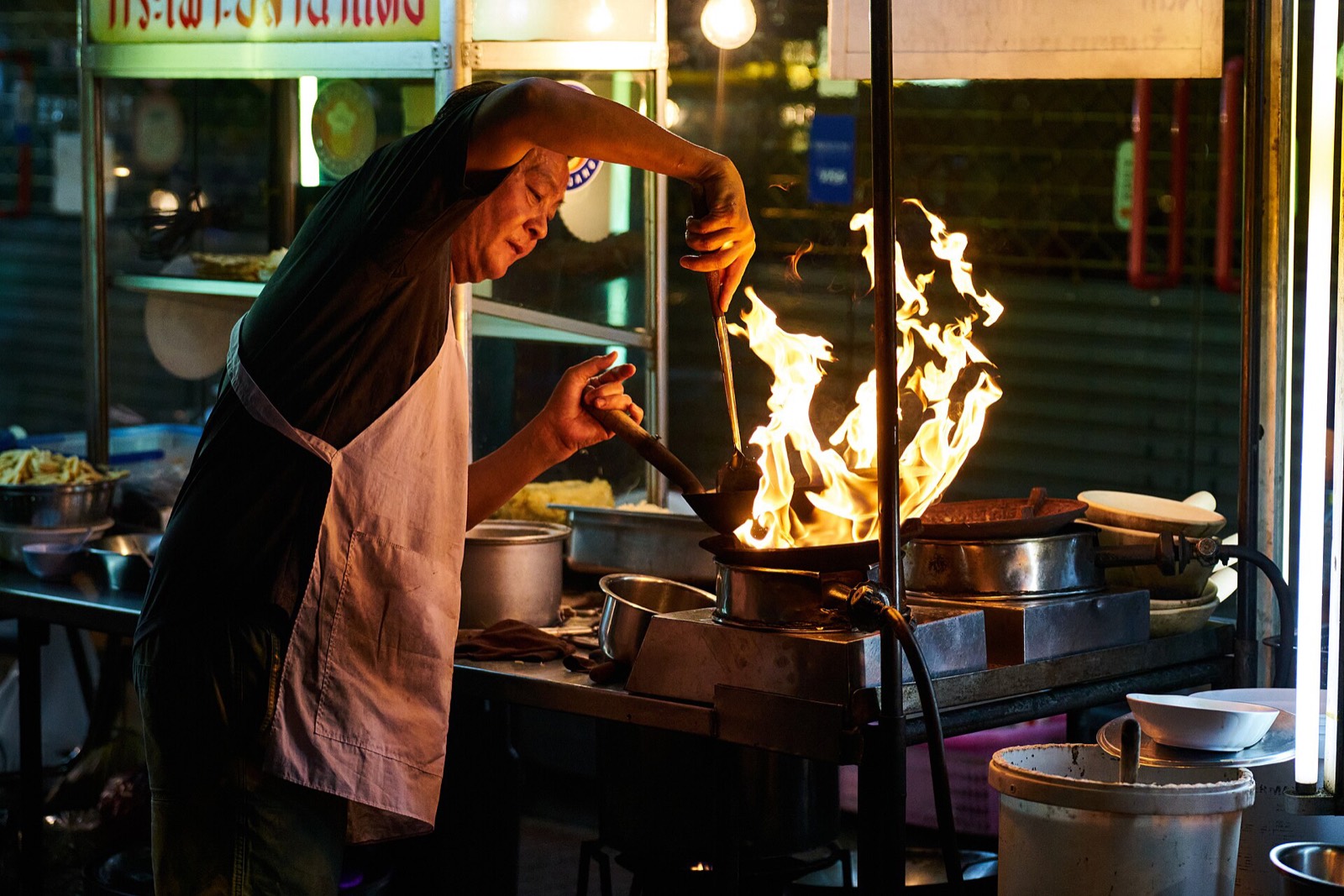
Bangkok food,
decided.
Time Out ranked Bangkok the #2 food city in the world in 2025, and it earns it at both ends: ฿50 chicken rice and two three-star tasting rooms in the same city. But the map you saw on YouTube is out of date. Sidewalk vendors are down more than 60% since 2022 — roughly 10,000 fewer operators — pushed into organized hawker centers, and half the night markets you've bookmarked are closed. The eating is still spectacular; it just consolidated. Start with the neighborhood ranking below, then go deeper: street food and the legendary stalls, which food tour to book, or Michelin without the ฿16,000 bill.
No, street food is not banned
You'll read that Bangkok 'banned street food.' It's false — but something real is happening. City hall has been clearing mobile vendors off the sidewalks for years, and the numbers are stark: sidewalk vendors are down more than 60% since 2022, roughly 10,000 fewer operators. They didn't vanish; they were pushed into designated hawker centers, the newest of which opened near Lumpini in April 2026. Informal sidewalk vending is falling, organized hawker centers are rising — and the same cooks are behind the same woks, now with a roof, a table, and usually a toilet nearby.
What this means for you: the plastic-stool-on-the-curb photo is getting harder to take, but the food itself is easier to eat than ever. The evening street theaters that survive — Yaowarat above all — are the ones worth planning a night around. The rest of the canon has consolidated into markets and centers, which is why our street food guide reads like a status board: half of what other sites still recommend closed in the last 18 months.
Bangkok's food neighborhoods, in order
Yaowarat / Chinatown — the evening street-food theater
The best single food night in Bangkok, full stop. The neon gold-shop artery turns into a shoulder-to-shoulder eating street from about 6pm — Bib Gourmand noodle shops next to charcoal woks next to dessert carts. Plan one dinner here minimum; our street food guide maps the stalls worth queuing for.
Charoenkrung / Bang Rak — heritage eats on the river axis
Bangkok's first paved road is its legendary old food district: Prachak duck since 1909, Jok Prince congee, the Muslim quarter around Haroon Mosque, and Baan Phadthai — the Bib Gourmand pad thai the foodies actually endorse. Pairs with the Talad Noi café wave next door.
Banthat Thong — the Gen-Z food street, mid-correction
The 'second Yaowarat' boom broke: rents spiked, revenue is down about 50%, and 30-year stalwarts are closing. Still worth one night — Jeh O Chula's viral tom yum mama is here — but go knowing you're watching a hype cycle correct in real time, not discovering the next big thing.
Thonglor / Ekkamai — upscale plates and a 50-year broth
Where hi-so Bangkok eats and drinks: the polished end of the scene, plus Wattana Panich — the beef-noodle shop whose broth has been simmering for 50 years, ฿100–150 (~$3–4.50) a bowl. Come for a splurge dinner, stay for the cocktail rooms.
Victory Monument — the boat-noodle alley
Tiny bowls of boat noodles at ฿20–25 (~$0.60–0.75) each — you order by the stack and photograph the tower of empties. The cheapest legendary meal in Bangkok, two minutes from the BTS.
Wang Lang — Thonburi's market maze
Across the river by boat, almost no tourists, plates at ฿20–60 (~$0.60–1.80). This is what eating in Bangkok looked like before the consolidation — go at lunch, follow the office workers and hospital staff, point at what they're having.
Or Tor Kor — the answer for hygiene-nervous eaters
A world-class premium market: spotless, orderly, with a cooked-food hall where plates run ฿60–150 (~$2–4.50). If someone in your group is nervous about street food, don't argue — bring them here first. Across the road from Chatuchak.
Vegetarian, vegan, halal — and the spice problem
Vegetarian and vegan: easier than you've heard. The magic word is 'jay' (เจ) — the strict Buddhist vegan standard — and stalls flying yellow flags cook to it. Dedicated spots like Broccoli Revolution cover the café end, and if you're here in October, the Vegetarian Festival turns Yaowarat almost entirely vegan under yellow flags. Fish sauce hides everywhere, so say 'jay' rather than negotiating ingredient by ingredient.
Halal: the historic quarter around Haroon Mosque in Bang Rak is the heritage answer — biryani and oxtail-soup shops that predate the skyscrapers around them. Sukhumvit Soi 3, 'Little Arabia,' runs halal grills and shisha late into the night. Bangkok's Muslim food history is old and excellent; this is not an afterthought scene.
Spice, honestly: 'pet nit noi' — 'a little spicy' — still means very spicy. Thai kitchens calibrate to Thai palates, and your polite request moves the dial one notch, not five. Order 'mai pet' (not spicy) if you mean it, keep rice close, and know that the chili caddy on every table exists to add heat, not remove it.
Will street food make you sick? The honest odds
The rule that actually works: a busy stall is a safe stall. High turnover means nothing sits around, and a vendor who has fed the same block for 20 years has a reputation no hygiene certificate can match. The wok you watched your food come out of is the safest kitchen in Bangkok.
The real culprits are quieter: pre-cut fruit sitting on ice (study-confirmed contamination), warm buffet trays holding food at bacteria temperature, and raw seafood anywhere you can't vouch for the cold chain. Skip those three and your odds improve dramatically. The factory ice is fine — the cylindrical kind with the hole through it is machine-made and safe; it's in every drink in the city. Tap water, no: drink bottled and treat the 7-Eleven on every corner as hydration infrastructure.
The bookable shortcuts
You can eat brilliantly in Bangkok with zero bookings. Pay for exactly two things: a first-night food tour that hands you the map, and a restaurant shortlist you trust.
FAQ
Is street food banned in Bangkok?
No — that headline is wrong, but it points at something real. Sidewalk vendors are down more than 60% since 2022 (roughly 10,000 fewer operators) because the city pushed mobile vendors into designated hawker centers — the newest opened near Lumpini in April 2026. The food survived; the sidewalk romance is what's shrinking. Yaowarat's evening street theater is the great exception and still going strong.
What is the best area in Bangkok for street food?
Yaowarat (Chinatown) in the evening, and it isn't close. From about 6pm the whole artery becomes an eating street — Bib Gourmand noodle shops, charcoal seafood woks, dessert carts — two minutes from MRT Wat Mangkon. Second and third place go to Charoenkrung/Bang Rak for heritage shophouse eats and Victory Monument's boat-noodle alley for the cheapest legendary meal in town.
Is Bangkok street food safe to eat?
Statistically, yes — with three exceptions. Follow the busy-stall rule (high turnover = fresh food), and skip the actual culprits: pre-cut fruit, warm buffet trays, and raw seafood of unverifiable provenance. The cylindrical factory ice with the hole through it is machine-made and fine; tap water is not. Cooked-to-order food from a stall with a queue beats a quiet air-conditioned buffet every time.
Is Bangkok good for vegetarians and vegans?
Yes, if you learn one word: 'jay' (เจ), the strict Buddhist vegan standard — stalls flying yellow flags cook to it, and it beats itemizing ingredients since fish sauce hides in everything. Broccoli Revolution anchors the café end, and October's Vegetarian Festival turns Yaowarat nearly all-vegan for the duration.
Where do I find halal food in Bangkok?
Two answers by mood: the Haroon Mosque quarter in Bang Rak for heritage — biryani and oxtail-soup shops generations deep — and Sukhumvit Soi 3, 'Little Arabia,' for late-night grills and shisha. Both are destination-grade eating in their own right, not compromise options.
How spicy is 'a little spicy' in Thailand?
Spicier than you think. 'Pet nit noi' (a little spicy) still lands very spicy by most visitors' standards, because kitchens calibrate to Thai palates and your request moves the dial one notch. If you genuinely can't do heat, say 'mai pet' (not spicy) and accept that some dishes simply don't exist without it — a tom yum with no chili isn't a tom yum.
Continue planning
Eat it with a local
Bangkok food tours & tastings — guided street-food crawls and cooking classes with vetted operators, most with free cancellation.